
Friday, October 16, 2015

Monday, October 12, 2015
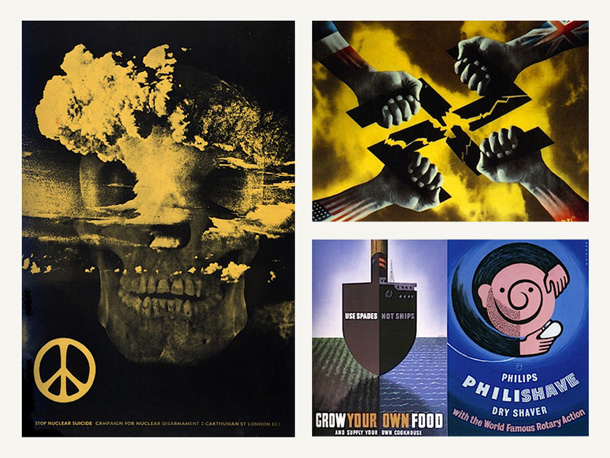
Posters of war
The Bauhaus School of Design
Beat the Whites with the red wedge - 1920

James Montgomery Flagg WWI Posters

WW2


FHK Henrion
Joost Schmidt (1893-1948)
This is probably one of the best know advertising posters for a Bauhaus exhibition. I love this piece because it really shows off the Bauhaus style and is so unique.

Sunday, October 11, 2015
Bauhaus
The Bauhaus was founded in 1919 by German architect Walter Gropius (1883–1969) just after WW1. Its core objective was a radical concept: to re imagine the material world to reflect the unity of all the arts. The Bauhaus combined elements of both fine arts and design education.


The Bauhaus chair design is one of the most famous styles of this and has changed a lot throughout the years but still keeping the Bauhaus style.

The Bauhaus building in Dessau, where the school was located from 1925-1933
Saturday, October 10, 2015
Vladyslav Krasnoshchok & Sergiy Lebedynsky


These are photo books created to show the work of these photographers. They were artists of WW1 and have some stunning photos of this time that give a real in site to the world then.
Wednesday, October 7, 2015

Monday, October 5, 2015
Art & The First World War
The First World War was the first conflict to spawn a lot of artistic output from those who fought on its battlefields.
Works by Wyndham Lewis and Paul Joostens depict soldiers and machines as nearly abstract geometric forms.

PAUL NASH: We are making a new world (1918)

DAVID BOMBERG: Sappers at work (1918-19)
This incorporates the styles of cubism, futurism and Vorticism.

Photography became more important as the era developed. In America, this was largely due to the influential activities of Alfred Stieglitz, who founded the Photo-Secession at his "291" gallery in New York.

Sunday, October 4, 2015


1914-1925
CUBISM
(1907-1915)
Cubism was invented around 1907 in Paris by Pablo Picasso and Georges Braque. It was the first abstract style of modern art. Cubist paintings ignore the traditions of perspective drawing and show you many views of a subject at one time. The Cubists believed that the traditions of Western art had become exhausted and to revitalize their work, they drew on the expressive energy of art from other cultures, particularly African art.
FUTURISM
(1909-1914)
Futurism was a revolutionary Italian movement that celebrated modernity. The Futurist vision was outlined in a series of manifestos that attacked the long tradition of Italian art in favor of a new avant-garde. They glorified industrialization, technology, and transport along with the speed, noise and energy of urban life.
FAUVISM
(1905-1910)
Fauvism was a joyful style of painting that delighted in using outrageously bold colours. It was developed in France at the beginning of the 20th century by Henri Matisse and André Derain.
GERMAN EXPRESSIONISM
(1905-1925)
German Expressionism is a style of art that is charged with an emotional or spiritual vision of the world. The expressive paintings of Vincent Van Gogh and Edvard Munch influenced the German Expressionists. They also drew their inspiration from German Gothic and 'primitive art'.
ABSTRACT ART
(C.1907 ONWARD)
Abstract Art is a generic term that describes two different methods of abstraction: 'semi abstraction' and 'pure abstraction'. The word 'abstract' means to withdraw part of something in order to consider it separately.
SUPREMATISM
(C.1915-1925)
Suprematism was developed in 1915 by the Russian artist Kazimir Malevich. It was a geometric style of abstract painting derived from elements of Cubism and Futurism. Malevich rejected any use of representational images, believing that the non-representational forms of pure abstraction had a greater spiritual power and an ability to open the mind to ‘the supremacy of pure feeling’.
CONSTRUCTIVISM
(C.1913-1930)
Constructivism used the same geometric language as Suprematism but abandoned its mystical vision in favor of their 'Socialism of vision' - a Utopian glimpse of a mechanized modernity according to the ideals of the October Revolution.
DE STIJL
(C.1917-1931)
De Stijl was a Dutch 'style' of pure abstraction developed by Piet Mondrian, Theo Van Doesburg and Bart van der Leck.
Thursday, October 1, 2015
Art styles 1900-1915
VIENNA 1900
In Austria 1897 - the Vienna Secession marks the birth of modern art.
-Nineteen artists led by Gustav Klimt pulled out of the traditional Künstlerhaus on 24 May 1897 and founded the “Association of visual artists Austria, Secession”.
Produced journal ‘ Ver Sacrum’ it provided the young artists with the possibility to present their art works to a large audience.
Wanted to teach the inhabitants of Vienna modern art, organized big international exhibitions and for the first time brought artists like van Gogh or French impressionists to Vienna.
1908 – Converse Rubber Corporation. First converse shoes made and have carried on until now. You can notice the company converse by there distinct logo.

PARIS EXPO 1900
The Exposition Universelle of 1900 was a world's fair held in Paris, France, from 15 April to 12 November 1900, to celebrate the achievements of the past century and to accelerate development into the next. The style that was universally present in the Exposition was Art Nouveau.
Alfred Kubin
The deeply disturbing imagery of the graphics by Alfred Kubin reveals abysses of the human existence. Fear, hopelessness and dark instincts seemingly drive our life that resembles a nightmare.
Alfred Stieglitz's - art dealer, exhibition organizer, publisher, editor ,photographer.
The rise of modern photography in America in the early years of the twentieth century, publishing the periodical Camera Work (1903-17) and forming the exhibition society, the Photo-Secession.
Ran a series of influential galleries, starting with 291, which he used not only to exhibit photography, but also to introduce European modernist painters and sculptors to America and to foster America's own modernist figures.
Salvador Dali
Born in 1904 and ended up becoming the leader of the Surrealist Movement.

Subscribe to:
Posts (Atom)